Publications from The Miller Lab at The University of Chicago
Z. Ding, S. Emami, G. Salvi, C. Tosciri, A. Gandrakota, J. Ngadiuba, N. Tran, C. Herwig, D. W. Miller, Y. Chen, "Learning to Trigger: Reinforcement Learning at the Large Hadron Collider" Best Paper Award, AI4Physics @ ICML 2026 [arXiv:2606.23993] (2026)
Trains a reinforcement-learning agent to automatically tune LHC trigger thresholds in real time as detector conditions drift, rather than relying on static, hand-tuned menus. Shown to work not just in simulation but on real CMS collision data, marking the first demonstration of RL-based trigger control on LHC data.
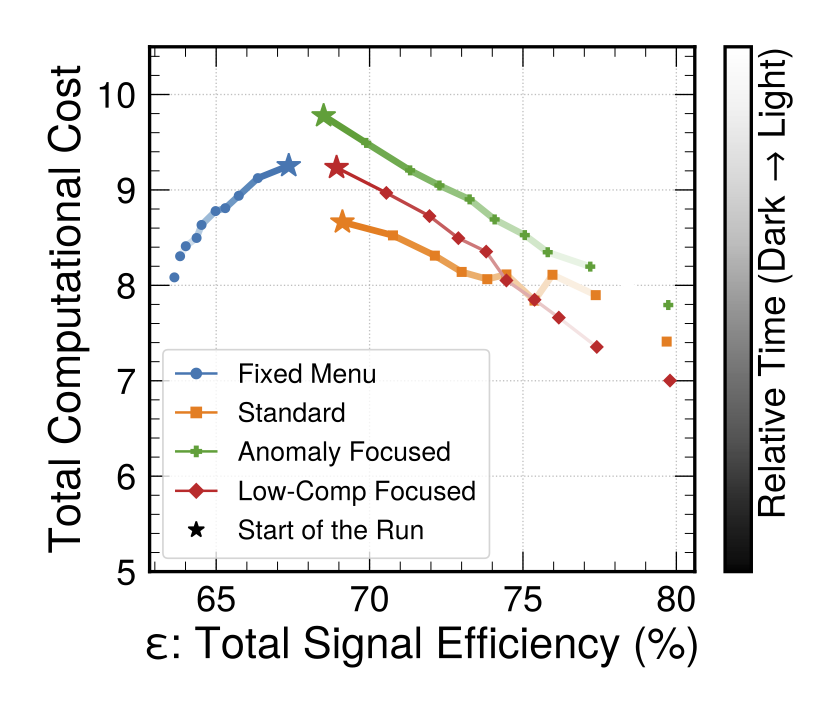
N. Clarke Hall, I. Xiotidis, N. Konstantinidis, D. W. Miller, "End-to-end optimisation of HEP triggers" [arXiv:2603.08428] (2026)
Explores jointly optimizing trigger selection algorithms against upstream embedded system constraints and downstream physics performance, rather than tuning trigger stages in isolation.

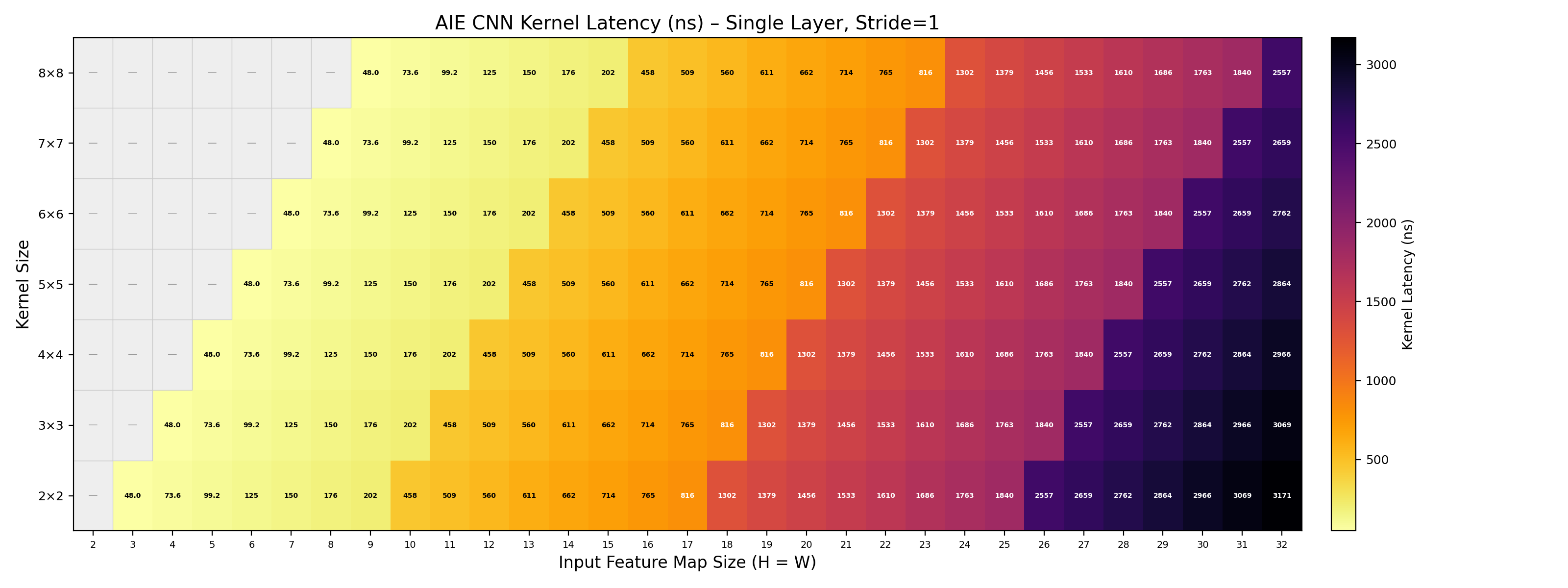
I. Xiotidis, N. Clarke Hall, T. Du, N. Konstantinidis, D. W. Miller, "AMD Versal AI-Engines for fixed latency environments" [arXiv:2603.13852] (2026)
Studies deploying machine-learning inference on AMD Versal AI Engines for real-time trigger hardware, focusing on achieving strict, deterministic latency guarantees required for collider trigger decisions.
Kristin Dona, Jan Offermann, Ben Rosser, David Miller (+ ATLAS collaborators), "Search for displaced decays of long-lived particles in events with missing transverse momentum in √s = 13 TeV pp collisions with the ATLAS detector" accepted by JHEP [arXiv:2603.12051] (2026)
Searches for new particles with experimental sigantures of displaced vertices combined with missing transverse momentum. In particular, we place constraints on axinos, the supersymmetric partner of the axion, using the model developed in the paper below (Hoshino, et al, Bridging the divide: axion searches and axino phenomenology at colliders).

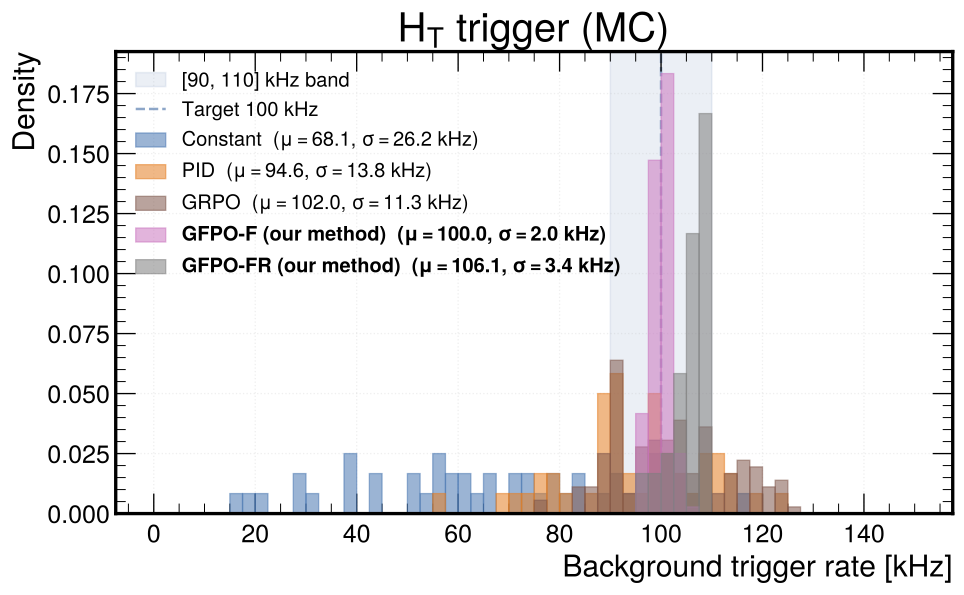
S. Emami, C. Tosciri, G. Salvi, Z. Ding, Y. Chen, A. Gandrakota, C. Herwig, D. W. Miller, J. Ngadiuba, N. Tran, "Towards a Self-Driving Trigger at the LHC: Adaptive Response in Real Time" accepted by Mach. Learn.: Sci. Technol. [arXiv:2601.08910] (2026)
Proposes a multi-tier framework using dynamic controls based on traditional PID-loop style operations to let LHC trigger systems adapt autonomously to changing beam and detector conditions, laying groundwork for a fully self-driving trigger. Followed-up by the paper above which implements a full reinforcement learning (RL) approach to trigger control and operations (Ding, et al, Learning to Trigger: Reinforcement Learning at the Large Hadron Collider).
G. Hoshino, K. Dona, K. Harigaya, D. W. Miller, J. T. Offermann, B. Pol, B. Rosser, C. Tosciri, "Bridging the divide: axion searches and axino phenomenology at colliders" accepted by JHEP [arXiv:2511.07224] (2025)
Connects two normally separate search strategies for axion-like particles, direct-detection haloscope experiments like BREAD and collider searches for the axino, the axion's supersymmetric partner, showing how the two approaches constrain complementary regions of parameter space.

Gabe Hoshino, David W. Miller (+ BREAD collaborators), "First Axion-Like Particle Results from a Broadband Search for Dark Matter in the 44 to 52 ueV Range with a Coaxial Dish Antenna" Submitted to PRL [arXiv:2501.17119]
Reports the BREAD experiment's first constraints on axion-like particle dark matter coupling to photons in the 44–52 ueV mass range, using a broadband coaxial dish antenna haloscope operated inside of a 3.9 T solenoidal magnetic field.

Emily Smith, David W. Miller (+ ATLAS Collaborators), "Measurements of Lund subjet multiplicities in 13 TeV proton-proton collisions with the ATLAS detector" Phys. Lett. B 859 (2024) 139090 [arXiv:2402.13052]
Measures how jets radiate additional lower-energy sub-structure (subjets) using the Lund plane, a tool for visualizing parton splittings, providing a precision test of QCD radiation patterns and Monte Carlo generators.

Mark Oreglia, David W. Miller (+ ATLAS Collaborators), "Operation and performance of the ATLAS tile calorimeter in LHC Run 2" Eur. Phys. J. C 84 (2024) 1313 [arXiv:2401.16034]
Comprehensive overview of the Tile Calorimeter's operation, calibration, and performance during LHC Run 2 (2015–2018), during which it maintained 99.65% data-taking efficiency.

Stefan Knirck, Gabe Hoshino, Andrew Sonnenschein, David W. Miller (+ BREAD Collaborators), "First Results from a Broadband Search for Dark Photon Dark Matter in the 44 to 52 ueV Range with a Coaxial Dish Antenna" Phys. Rev. Lett. 132, 131004 [arXiv:2310.13891]
The BREAD collaboration's first published results, setting limits on dark photon dark matter in the 44–52 ueV range using a novel coaxial dish antenna design, presenting physics results from our broadband haloscope concept for the first time.

ATLAS Collaboration, "The ATLAS Experiment at the CERN Large Hadron Collider: A Description of the Detector Configuration for Run 3" JINST 19 (2024) P05063 [arXiv:2305.16623]
Reference paper documenting the full ATLAS detector configuration for LHC Run 3, including the upgraded trigger system components such as the global feature extractor (gFEX).

Alex Bogatskiy, Timothy Hoffman, David W. Miller, Jan T. Offermann, Xiaoyang Liu, "Explainable Equivariant Neural Networks for Particle Physics: PELICAN" JHEP 03 (2024) 113 [arXiv:2307.16506]
Introduces PELICAN, a neural network architecture built to respect the Lorentz symmetry of particle physics data by construction, achieving both strong performance and interpretability for tasks like jet tagging. The seeds of this idea were planted with the Lorentz Group Network (LGN) described in the paper below.

C. B. Adams, and other collaborators, "Axion Dark Matter" Contribution to Snowmass 2021 [arXiv:2203.14923]
A community white paper for the Snowmass 2021 process surveying the landscape of axion dark matter searches and outlining priorities for the field over the coming decade.

Rainer Bartoldus, Catrin Bernius, David W. Miller, "Innovations in trigger and data acquisition systems for next-generation physics facilities" Contribution to Snowmass 2021 [arXiv:2203.07620]
Snowmass 2021 white paper reviewing emerging trigger and data acquisition technologies, including real-time AI/ML and heterogeneous computing, needed to handle the data rates of future high-luminosity physics facilities.

Alexander Bogatskiy, Risi Kondor, David W. Miller, Jan T. Offermann, and other collaborators, "Symmetry Group Equivariant Architectures for Physics" Contribution to Snowmass 2021
Snowmass 2021 white paper making the case for building physical symmetries directly into machine learning architectures, surveying equivariant approaches and their advantages for physics applications.

David W. Miller (+ ATLAS Collaborators), "Emulating the impact of additional proton-proton interactions in the ATLAS simulation by pre-sampling sets of inelastic Monte Carlo events" Comput Softw Big Sci 6, 3 (2022) [arXiv:2102.09495]
Describes a computationally efficient technique for simulating pileup, the extra proton-proton collisions that occur alongside the collision of interest, by pre-sampling and overlaying sets of minimum-bias events.

Jesse Liu, Kristin Dona, Gabe Hoshino, Stefan Knirck, Noah Kurinsky, Matthew Malaker, David W. Miller, Andrew Sonnenschein, and other collaborators, "Broadband solenoidal haloscope for terahertz axion detection" Phys. Rev. Lett. 128 (2022) 131801 [arXiv:2111.12103]
Proposes the original broadband haloscope concept that became the BREAD experiment: converting axion dark matter into detectable photons across a wide terahertz frequency range using a dish antenna inside a strong magnet with the ability to swap in and out different sensors to cover different mass ranges and performance criteria.

ATLAS Collaboration, "Search for charginos and neutralinos in final states with two boosted hadronically decaying bosons and missing transverse momentum in pp collisions at sqrt{s}=13 TeV with the ATLAS detectors" Phys. Rev. D 104 (2021) 112010 [arXiv:2108.07586]
Searches for supersymmetric charginos and neutralinos by looking for pairs of highly boosted W, Z, or Higgs bosons decaying hadronically, alongside missing transverse momentum from undetected particles.

Chinmaya Mahesh, Kristin Dona, David W. Miller, Yuxin Chen, "Towards an Interpretable Data-driven Trigger Systemfor High-throughput Physics Facilities" NeurIPS Machine Learning for Physical Sciences, 2020 (also at arXiv:2104.06622)
Early exploration of data-driven, machine-learning-based trigger decisions with an emphasis on interpretability, understanding why a model flags an event as interesting rather than treating it as a black box.

Kristin Dona, Jesse Liu, Noah Kurinsky, David Miller, Pete Barry, Clarence Chang, Andrew Sonnenschein, "Design and performance of a multi-terahertz Fourier transform spectrometer for axion dark matter experiments" Preprint available at arXiv:2104.07157, to be submitted to the Journal of Infrared, Millimeter, and Terahertz Waves
Describes the design and characterization of a multi-terahertz Fourier transform spectrometer built to calibrate and characterize instrumentation for axion dark matter searches like BREAD.

MilliQan Collaboration, "Sensitivity to millicharged particles in future proton-proton collisions at the LHC" Phys. Rev. D 104 (2021) 032002 [arXiv:2104.07151]
Projects the sensitivity of the MilliQan detector to hypothetical particles carrying a tiny fraction of the electron's charge, in future higher-luminosity LHC running.

Jona Bossio (McGill), Kate Pachal (Duke), David Miller (+ ATLAS collaborators), "Jet energy scale and resolution measured in proton-proton collisions at sqrt(s)=13 TeV with the ATLAS detector" Eur. Phys. J. C 81 (2021) 689 [arXiv:2007.02645]
Establishes the calibration and uncertainty of jet energy measurements in ATLAS for the full 13 TeV dataset, representing a foundational input used by essentially all ATLAS analyses involving jets.

Alexander Bogatskiy, Brandon Anderson, Jan T. Offermann, Marwah Roussi, David W. Miller, Risi Kondor, "Lorentz Group Equivariant Neural Network for Particle Physics" Proceedings of the International Conference on Machine Learning (ICML 2020) [arXiv:2006.04780]
Introduces the Lorentz Group Network (LGN), the first neural network architecture designed to respect the fundamental Lorentz symmetry of particle physics data, and the conceptual precursor to PELICAN, which is described in the paper above.

milliQan Collaboration (incl. David Miller, Max Swiatlowski, and Henry Zheng from UChicago), "Search for millicharged particles in proton-proton collisions at sqrt(s)=13 TeV" Phys. Rev. D 102, 032002 (2020) [arXiv:2005.06518]
Reports the first search results from the MilliQan demonstrator detector for particles with tiny fractional electric charge produced in LHC collisions.

Chris Delitzsch (Arizona), Reina Camacho (CNRS Paris), David Miller (+ ATLAS collaborators), "Measurement of the jet mass in high transverse momentum Z(-> bb)+photon production at sqrt(s)=13 TeV using the ATLAS detector" Phys. Lett. B 812 (2020) 135991 [arXiv:1907.07093]
Measures the jet mass of boosted Z bosons decaying to bottom quark pairs, testing jet substructure techniques used to identify heavy boosted particles which are major backgrounds to the measurements of boosted Higgs bosons that also decay to pairs of bottom quarks.

Chris Delitzsch (Arizona), Reina Camacho (CNRS Paris), David Miller (+ ATLAS collaborators), "Identification of boosted Higgs bosons decaying into b-quark pairs with the ATLAS detector at 13 TeV" Eur. Phys. J. C 79 (2019) 836 [arXiv:1906.11005]
Develops and characterizes techniques for identifying highly boosted Higgs bosons that decay into bottom-quark pairs, an increasingly important signature at high-energy LHC running.

Peter Berta, Lucia Masetti, David W. Miller, Martin Spousta, "Pileup and Underlying Event Mitigation with Iterative Constituent Subtraction" JHEP 08 (2019) 175 [arXiv:1905.03470]
Presents an iterative algorithm for removing the contamination from pileup and the underlying event at the level of individual particles within a jet, improving jet mass and substructure resolution.

Joakim Olsson, Reina Camacho, David Miller (+ ATLAS collaborators), "Search for chargino and neutralino production in final states with a Higgs boson and missing transverse momentum at sqrt(s)=13 TeV with the ATLAS detector" Phys. Rev. D 100, 012006 (2019) [arXiv:1812.09432]
Searches for supersymmetric charginos and neutralinos in events containing a Higgs boson (decaying to b-quark pairs) plus missing transverse momentum from undetected particles.

Giordon Stark, Max Swiatlowski, David Miller (+ ATLAS collaborators), " Search for gluino-mediated stop and sbottom pair production in events with b-jets and large missing transverse momentum" ATLAS-CONF-2018-041 (2018)
Preliminary conference-note version of a SUSY search for gluinos decaying via top or bottom squarks, using events with multiple b-tagged jets and large missing transverse momentum.

Giordon Stark, Max Swiatlowski, David Miller, Patrick Bryant, John Alison, Mel Shochet (+ ATLAS collaborators), "Search for pair production of higgsinos in final states with at least three b-tagged jets in sqrt(s)=13 TeV pp collisions using the ATLAS detector" Phys. Rev. D 98, 092002 (2018) [arXiv:1806.04030]
Searches for pair-produced higgsinos decaying into final states rich in bottom quarks, a natural supersymmetric dark-matter candidate scenario, using events with three or more b-tagged jets.

Giordon Stark, Max Swiatlowski, David Miller (+ ATLAS collaborators), "Search for supersymmetry in final states with missing transverse momentum and multiple b-jets in proton-proton collisions at sqrt(s)=13 TeV with the ATLAS detector" JHEP 06 (2018) 107 [arXiv:1711.01901]
Broad SUSY search targeting gluino and squark production in final states with multiple bottom-quark jets and large missing transverse momentum, using the full early Run 2 dataset.

Max Swiatlowski (+ ATLAS collaborators), "A measurement of the soft-drop jet mass in pp collisions at sqrt(s)=13 TeV with the ATLAS detector" Phys. Rev. Lett. 121, 092001 (2018) [arXiv:1711.08341]
Precision measurement of the soft-drop jet mass, an observable designed to be theoretically well-controlled by removing soft, wide-angle radiation, providing a stringent test of perturbative QCD predictions.

Reina Camacho (+ ATLAS collaborators), "Search for diboson resonances with boson-tagged jets in pp collisions at sqrt(s)=13 TeV with the ATLAS detector" Phys. Lett. B 777 (2017) 91 [arXiv:1708.04445]
Searches for new heavy particles decaying to pairs of W or Z bosons, using jet-tagging techniques to identify boosted, hadronically-decaying bosons reconstructed as single large-radius jets.

Max Swiatlowski (+ ATLAS collaborators), "Jet reclustering and close-by effects in ATLAS Run 2 " ATLAS-CONF-2017-062 (2017)
Technical study of jet reclustering, building large-radius jets from smaller-radius jets, and how nearby jets affect the technique's performance in ATLAS Run 2 conditions.
Reina Camacho (+ ATLAS collaborators), "Search for heavy resonances decaying to a W or Z boson and a Higgs boson in the qqbb final state in pp collisions at sqrt(s)=13 TeV with the ATLAS detector" Phys. Lett. B 774 (2017) 494 [arXiv:1707.06958]
Searches for new heavy resonances decaying into a W or Z boson plus a Higgs boson, reconstructed via two quark jets and two bottom-quark jets — a channel sensitive to several beyond-Standard-Model theories.

Max Swiatlowski (+ ATLAS collaborators), "Jet energy scale measurements and their systematic uncertainties in proton-proton collisions at sqrt(s)=13 TeV with the ATLAS detector" Phys. Rev. D 96, 072002 (2017) [arXiv:1703.09665]
Early Run 2 calibration paper establishing the jet energy scale and its systematic uncertainties, a critical input underlying nearly all ATLAS jet-based measurements.

Miles Wu, David Miller (+ ATLAS collaborators), "Measurement of W boson angular distributions in events with high transverse momentum jets at sqrt(s) = 8 TeV using the ATLAS detector" Phys. Lett. B 765 (2017) 132 [arXiv:1609.07045]
Measures the angular decay distributions of W bosons produced alongside high-momentum jets (i.e. collinear W emission, or sometimes called W-strahlung), probing the underlying production mechanism and testing QCD predictions.

Austin Ball, Jim Brooke, Claudio Campagnari, Albert De Roeck, Brian Francis, Martin Gastal, Frank Golf, Joel Goldstein, Andy Haas, Christopher S. Hill, Eder Izaguirre, Benjamin Kaplan, Gabriel Magill, Bennett Marsh, David Miller, Theo Prins, Harry Shakeshaft, David Stuart, Max Swiatlowski, Itay Yavin, "A Letter of Intent to Install a milli-charged Particle Detector at LHC P5" arXiv:1607.04669 (2016) [arXiv:1607.04669]
The founding proposal for the MilliQan experiment, laying out the physics case and detector concept for installing a dedicated millicharged-particle detector near the LHC's Compact Muon Solenoid interaction point.

Reina Camacho, David Miller (+ ATLAS collaborators), "Searches for heavy diboson resonances in pp collisions at sqrt(s) = 13 TeV with the ATLAS detector" JHEP 09 (2016) 173 [arXiv:1606.04833]
Combined search across multiple decay channels for new heavy particles decaying into pairs of W, Z, or Higgs bosons, one of the earliest comprehensive diboson resonance searches at 13 TeV.

Giordon Stark, Joakim Olsson, David Miller (+ ATLAS collaborators), "Search for pair production of gluinos decaying via stop and sbottom in events with b-jets and large missing transverse momentum in pp collisions at sqrt(s)=13 TeV with the ATLAS detector" Phys. Rev. D 94, 032003 (2016) [arXiv:1605.09318]
Early Run 2 SUSY search for gluino pair production decaying through top or bottom squarks, using b-jet multiplicity and missing transverse momentum to search for signs of supersymmetry.

Joakim Olsson, David Miller (+ ATLAS collaborators), "A search for top squarks with R-parity-violating decays to all-hadronic final states with the ATLAS detector in sqrt(s)=8 TeV proton-proton collisions" JHEP 06 (2016) 067 [arXiv:1601.07453]
Searches for top squarks decaying entirely into quarks (rather than leaving missing energy) under R-parity-violating supersymmetry scenarios, a challenging all-hadronic signature.

David Miller (+ ATLAS collaborators), "Performance of pile-up mitigation techniques for jets in pp collisions at sqrt(s)=8 TeV using the ATLAS detector [arXiv:1510.03823]" Eur. Phys. J. C (2016) 76:581
Evaluates and compares several techniques for mitigating the effects of pileup on jet reconstruction and calibration, including the jet vertex fraction (JVF) method.
![Performance of pile-up mitigation techniques for jets in pp collisions at sqrt(s)=8 TeV using the ATLAS detector [arXiv:1510.03823]](graphics/publications/JVF.png)
David Miller (+ ATLAS collaborators), "Properties of jets and inputs to jet reconstruction and calibration with the ATLAS detector using proton-proton collisions at sqrt(s)=13 TeV " ATL-PHYS-PUB-2015-036 (2015)
Public note characterizing basic jet properties at the start of 13 TeV running, forming part of the foundational inputs used for jet reconstruction and calibration in ATLAS.

Reina Camacho (+ ATLAS collaborators), "Expected Performance of Boosted Higgs (bb) Boson Identification with the ATLAS Detector at sqrt(s)=13 TeV " ATL-PHYS-PUB-2015-035 (2015)
Projects the expected performance of tagging techniques for identifying boosted Higgs bosons decaying to bottom-quark pairs, ahead of the start of 13 TeV data-taking.

Reina Camacho (+ ATLAS collaborators), "Identification of Boosted, Hadronically-Decaying W and Z Bosons in sqrt(s)=13 TeV Monte Carlo Simulations for ATLAS" ATL-PHYS-PUB-2015-033 (2015)
Simulation-based study of techniques for identifying highly boosted, hadronically-decaying W and Z bosons ahead of Run 2, establishing tagging performance expectations at 13 TeV.

Max Swiatlowski, Joakim Olsson, David Miller (+ ATLAS collaborators), "Search for massive supersymmetric particles decaying to many jets using the ATLAS detector in pp collisions at sqrt(s)=8 TeV" Phys. Rev. D 91, 112016 (2015) [arXiv:1502.05686]
Searches for massive supersymmetric particles decaying into many-jet final states (e.g., gluinos decaying to seven quarks each) with little or no missing energy, a challenging signature at hadron colliders.

Peter Berta, Martin Spousta, David W. Miller, Rupert Leitner, "Particle-level pileup subtraction for jets and jet shapes" JHEP 1406 (2014) 092 [arXiv:1403.3108]
Develops a particle-level method for subtracting pileup contamination from jets and jet-shape observables, an early precursor to the later constituent subtraction techniques.

David Miller (+ ATLAS collaborators), "Search for new phenomena in final states with large jet multiplicities and missing transverse momentum at sqrt(s)=8 TeV proton-proton collisions using the ATLAS experiment" JHEP 10 (2013) 130 [arXiv:1308.1841]
Broad, model-independent search for new physics in events with many jets and large missing transverse momentum, sensitive to a range of supersymmetric and exotic production scenarios.
