Our community roadmap white paper "Machine Learning on Heterogeneous, Edge, and Quantum Hardware for Particle Physics (ML-HEQUPP)", with David Miller and collaborators Ioannis Xiotidis and Christian Herwig among the editors, has been officially accepted to PRX Intelligence as a Roadmap!
David Miller was featured in a ProPublica feature, "How Trump's 'America First' Administration Could Shut U.S. Scientists Out of the Next Nobel-Worthy Discovery," also covered by CNN.
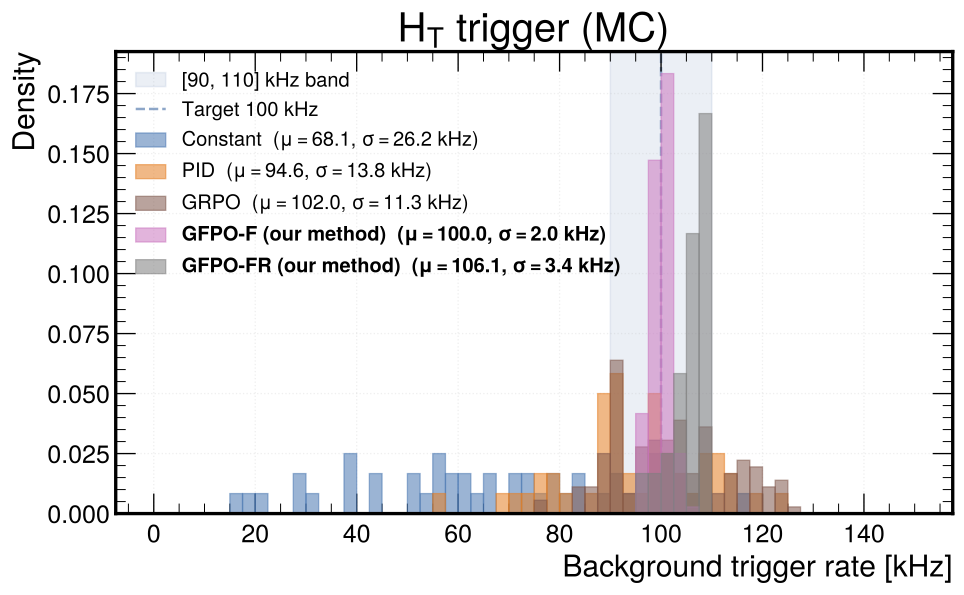
Christian Herwig presents work done with David Miller and Cecilia Tosciri on the self-driving trigger at the DPF 2026 Conference at Fermilab.
Gabe Hoshino presents BREAD at the DPF 2026 Conference at Fermilab.
Z. Ding, S. Emami, G. Salvi, C. Tosciri, A. Gandrakota, J. Ngadiuba, N. Tran, C. Herwig, D. W. Miller, Y. Chen, "Learning to Trigger: Reinforcement Learning at the Large Hadron Collider" Best Paper Award, AI4Physics @ ICML 2026 [arXiv:2606.23993] (2026)
***Trains a reinforcement-learning agent to automatically tune LHC trigger thresholds in real time as detector conditions drift, rather than relying on static, hand-tuned menus. Shown to work not just in simulation but on real CMS collision data, marking the first demonstration of RL-based trigger control on LHC data.***
N. Clarke Hall, I. Xiotidis, N. Konstantinidis, D. W. Miller, "End-to-end optimisation of HEP triggers" [arXiv:2603.08428] (2026)
***Explores jointly optimizing trigger selection algorithms against upstream embedded system constraints and downstream physics performance, rather than tuning trigger stages in isolation.***
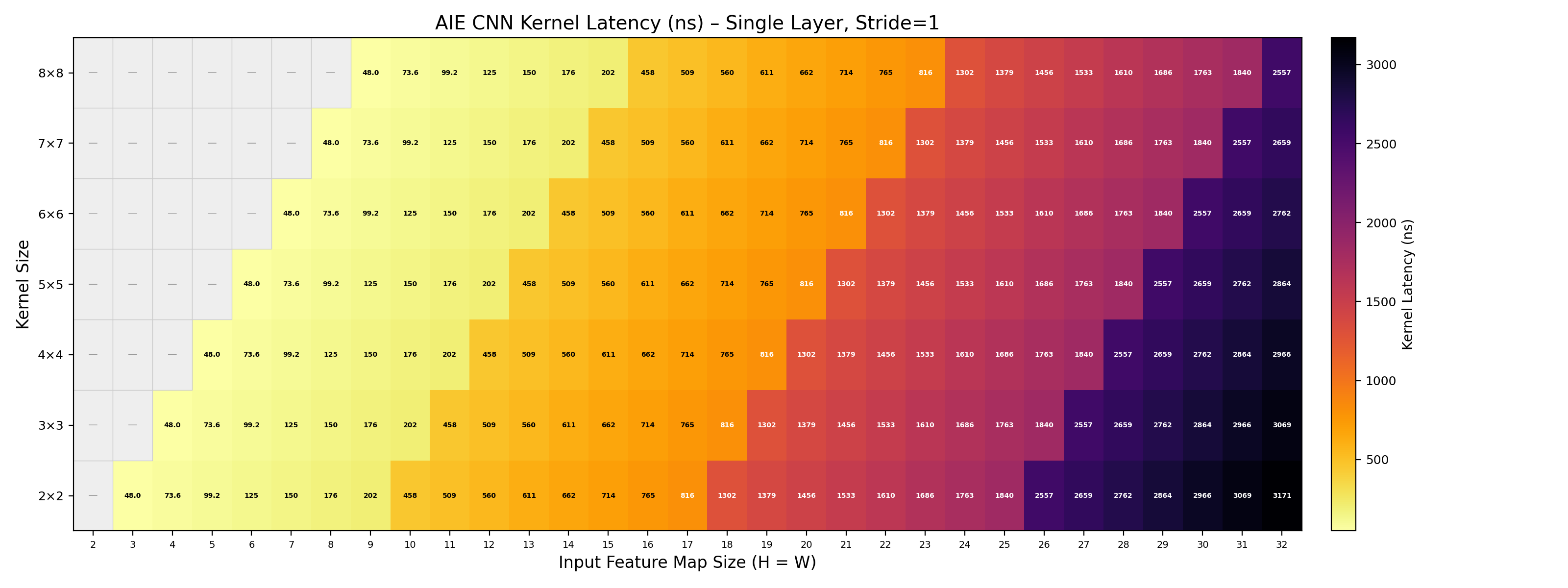
I. Xiotidis, N. Clarke Hall, T. Du, N. Konstantinidis, D. W. Miller, "AMD Versal AI-Engines for fixed latency environments" [arXiv:2603.13852] (2026)
***Studies deploying machine-learning inference on AMD Versal AI Engines for real-time trigger hardware, focusing on achieving strict, deterministic latency guarantees required for collider trigger decisions.***
Kristin Dona, Jan Offermann, Ben Rosser, David Miller (+ ATLAS collaborators), "Search for displaced decays of long-lived particles in events with missing transverse momentum in √s = 13 TeV pp collisions with the ATLAS detector" accepted by JHEP [arXiv:2603.12051] (2026)
***Searches for new particles with experimental sigantures of displaced vertices combined with missing transverse momentum. In particular, we place constraints on axinos, the supersymmetric partner of the axion, using the model developed in the paper below (Hoshino, et al, Bridging the divide: axion searches and axino phenomenology at colliders).***
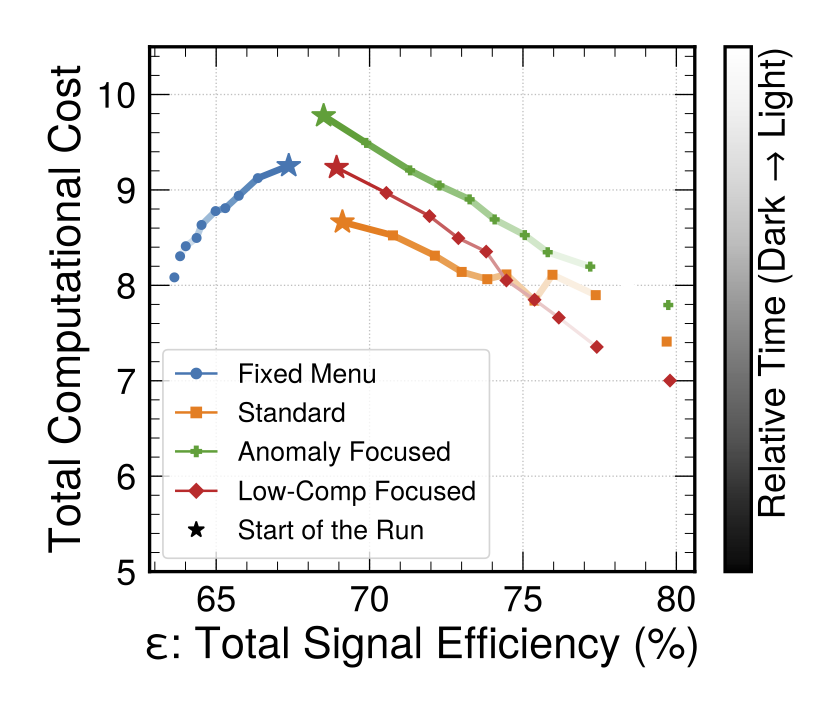
S. Emami, C. Tosciri, G. Salvi, Z. Ding, Y. Chen, A. Gandrakota, C. Herwig, D. W. Miller, J. Ngadiuba, N. Tran, "Towards a Self-Driving Trigger at the LHC: Adaptive Response in Real Time" accepted by Mach. Learn.: Sci. Technol. [arXiv:2601.08910] (2026)
***Proposes a multi-tier framework using dynamic controls based on traditional PID-loop style operations to let LHC trigger systems adapt autonomously to changing beam and detector conditions, laying groundwork for a fully self-driving trigger. Followed-up by the paper above which implements a full reinforcement learning (RL) approach to trigger control and operations (Ding, et al, Learning to Trigger: Reinforcement Learning at the Large Hadron Collider).***
G. Hoshino, K. Dona, K. Harigaya, D. W. Miller, J. T. Offermann, B. Pol, B. Rosser, C. Tosciri, "Bridging the divide: axion searches and axino phenomenology at colliders" accepted by JHEP [arXiv:2511.07224] (2025)
***Connects two normally separate search strategies for axion-like particles, direct-detection haloscope experiments like BREAD and collider searches for the axino, the axion's supersymmetric partner, showing how the two approaches constrain complementary regions of parameter space.***